We use cookies to make your experience better. To comply with the new e-Privacy directive, we need to ask for your consent to set the cookies. Learn more.
Insights
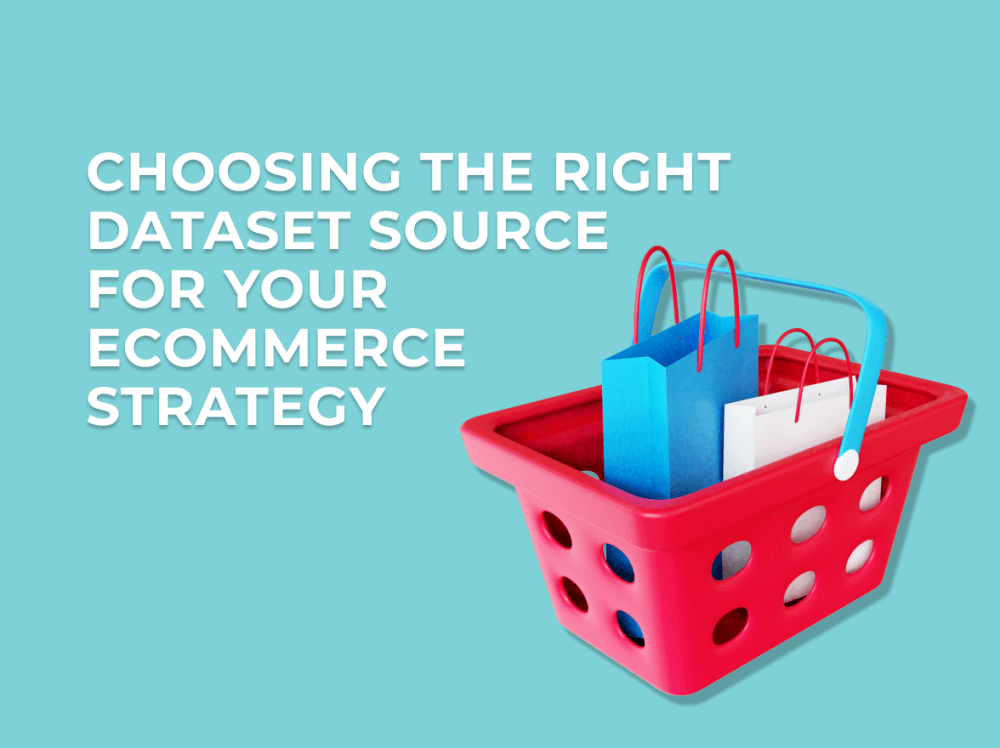
Choosing the right dataset source for your ecommerce strategy
on
January 15, 2026
Ecommerce datasets are becoming the backbone of strategic decision-making in the modern business landscape. With timely access to structured product data, pricing data, and marketplace data, companies can track competitors, forecast market shifts, refine planning, and make data-informed moves that fuel sustainable growth.
Ecommerce datasets, including product datasets and retail datasets, provide structured insights into product catalogs, pricing, availability, and market dynamics across online marketplaces.
Why manually track data when datasets exist?
Sure, you could hire a full-time analyst to monitor online stores, scrape data from various websites, and compile reports. But in a world where structured data is widely available — why spend the time and money doing it manually?
This is where datasets come in. These ready-to-use, structured data collections, including ecommerce datasets with product data, can save businesses hundreds of hours and provide scalable, repeatable, and accurate insights — often in real time or close to it.
Instead of collecting raw data, businesses can rely on ecommerce datasets that already combine product data, pricing data, and marketplace data.
What does competitor monitoring look like in practice?
Let’s imagine you run an online sports goods store and want to monitor your competitors. You’re particularly interested in extracting data from a specific retailer’s website (let’s call it XYZ.com) that includes:
- Product name
- Category
- Brand
- Price
- Country of origin
- Material
- Available sizes
- Available colors
So, the question arises — where can you find this kind of structured product data and build an ecommerce product dataset that fits your needs?
Are public ecommerce datasets a good place to start?
There are many publicly accessible eCommerce datasets available online, often published for academic research, benchmarking, or open data initiatives. These datasets may include products from popular brands and can serve as a great starting point for exploratory analysis.
Example:
UC Irvine Machine Learning Repository – Offers datasets like Online Retail or customer behavior logs that can be applied to eCommerce-related tasks.
Benefits:
- Free to use
- Easy to access
- Ideal for testing and proof-of-concept work
Drawbacks:
- Often outdated or based on historical data
- May not include current pricing, stock status, or specific store-level detail
- Typically anonymized or generalized — not tailored to a particular retailer like X.com
Use public datasets to validate hypotheses, train models, or explore initial ideas — but not for real-time business decisions.
Are data marketplaces worth it for ecommerce analytics?
Data marketplaces offer centralized access to licensed, curated, and enterprise-grade datasets, perfect for companies working in cloud environments or building data-powered applications.
Notable marketplaces:
- AWS Data Exchange – Retail pricing, demand analytics, supply chain data
- Datarade – Connects buyers with global data vendors
- Google Cloud Public Datasets – Retail and behavioral data via BigQuery
- Azure Open Datasets – Includes consumer behavior and logistics-related data
Pros:
- License clarity & compliance
- Cloud-native integration
- Frequent updates
- Niche dataset availability
Cons:
- Cost: High-quality data is often subscription-based
- Customization limits: You get pre-defined fields
- Cloud expertise needed: Technical setup may be required
- Vendor lock-in: Tied to specific platforms or ecosystems
Use marketplaces when you need trusted external data to augment internal analytics or support enterprise applications.
Can APIs provide structured product data at scale
While brands like Adidas may not offer public APIs for their own stores, you can indirectly access product data via large marketplaces that list their goods.
Examples:
- eBay Developer API
- Amazon Product Advertising API
- Zalando API
These APIs allow you to retrieve structured data, including pricing, product images, descriptions, and availability — often refreshed regularly.
Ideal for:
- Product feed ingestion
- App development
- Branded product monitoring at scale
When do third-party data providers make the most sense?
For businesses requiring large-scale, regularly updated, and store-specific data, third-party providers are a reliable option. These services are especially valuable for organizations that need highly customizable, country-specific, or category-specific datasets to power critical business decisions.
Here are several examples of such providers:
SSA Datasets
SSA Datasets, offered by SSA Group, provides professional data extraction and aggregation services tailored to specific business requirements. The portfolio includes datasets across multiple categories, addressing a wide range of use cases such as online directories (LinkedIn, Twitter), job market data (LinkedIn Jobs), real estate, search engines, cryptocurrency markets, and more.
The available datasets are not limited to those listed on the website. SSA Group can source and deliver data from virtually any publicly available online source, ensuring each dataset is fully customized to match your technical, geographic, and business needs.
SSA Datasets offers flexible configuration options, including:
- Delivery formats: CSV, JSON, XLS, XML
- Delivery methods: Amazon S3, Azure Blob Storage, FTP, Email, Dropbox, Google Drive, Microsoft OneDrive
- Update frequency: one-time delivery, daily, weekly, or monthly updates
- Customizable dataset attributes: tailored fields and structure based on project requirements
This flexibility allows organizations to integrate SSA Datasets seamlessly into existing analytics pipelines, BI tools, or data platforms while maintaining control over data structure, refresh cycles, and delivery channels.
Bright Data
A leading web data platform offering enterprise-grade access to real-time web data from virtually any source. Their services include large-scale data collection infrastructure, pre-collected datasets, and customizable scraping solutions.
Bright Data supports:
- Automated data pipelines
- Real-time web data feeds
- Geo-targeted data collection
- Compliance-first crawling
Their robust platform makes it easy to pull structured data at scale — especially useful for companies in retail, travel, finance, and market research.
ScrapeHero Data Store
A marketplace offering pre-built datasets on millions of products, locations, and services across various industries. ScrapeHero’s Data Store includes one-time downloadable datasets and subscription options for ongoing updates.
Available datasets include:
- Store locations and contact information
- Store openings, store closures, parking availability, in-store pickup options, services
- Store subsidiaries
- Nearest competitor stores
ScrapeHero also provides custom dataset development for niche use cases, including competitor tracking and industry-specific monitoring.
These providers offer unparalleled data depth and flexibility, making them ideal for businesses that need store-level granularity, customizable structure, and regular updates.
Whether you’re a retailer monitoring the competition, a consultant creating market reports, or an investor scanning price trends — third-party providers deliver the precision and reliability that off-the-shelf sources can’t match.
Where can you buy ready-made ecommerce datasets without building pipelines?
Instead of working with a single provider and to get immediate access to structured ecommerce data without building scrapers or managing infrastructure, businesses can use ecommerce datasets marketplaces like Datasets.store to compare multiple data sources and select datasets that best fit their use cases. It’s a convenient way to buy ecommerce datasets, buy ecommerce data, and quickly launch analytics without additional engineering effort.
Explore our ecommerce datasets marketplace to find datasets from multiple sources.
Datasets.store
Datasets.store is a platform where you can buy ecommerce datasets based on product and market data from leading ecommerce websites and online marketplaces. It’s a practical choice when you need a ready retail product dataset or a complete ecommerce product dataset for analytics and decision-making.
You can browse and purchase datasets by:
- Category (e.g., electronics, beauty, fashion, grocery)
- Subcategory (e.g., skincare, smartphones, footwear)
- Brand (e.g., Apple, L’Oréal, Nike)
- Data source (e.g., Amazon, Walmart, eBay)
The platform is designed to make data sourcing as easy as online shopping: select the dataset you need, choose the update frequency, and download ecommerce datasets that are ready for immediate use.
Every month, the system processes and refreshes tens of millions of product records from multiple ecommerce sources worldwide, ensuring each ecommerce dataset reflects up-to-date market dynamics — including pricing, promotions, availability, and customer reviews.
Ideal for: pricing intelligence, assortment optimization, competitor monitoring, and data-driven merchandising.
Can AI generate datasets for you?
With the rise of generative AI, it’s natural to wonder: Can I just ask an AI model to fetch this data for me?
Technically, yes — AI can assist in generating and structuring data, but there are limitations:
- AI can’t access real-time web data without integration with scrapers or APIs.
- Volume is restricted by performance and cost constraints.
- Web scraping involves technical hurdles like: CAPTCHA/reCAPTCHA challenges, IP rotation, proxy setup, and anti-bot systems
In many cases, using AI alone for data collection isn’t feasible without combining it with a robust data infrastructure.
AI can be part of your pipeline, but it won’t replace reliable, structured data sources.
So… How complete does your data need to be?
This is the critical question to ask before choosing a data strategy.
If you’re:
- Testing ideas or building an MVP → Use public datasets
- Monitoring pricing on branded goods → Use APIs or data marketplaces
- Running a high-stakes, data-powered business → Go for third-party providers or custom pipelines
The more specific and timely your data needs, the more robust your data infrastructure must be.
Final thoughts: How do you make data work for you?
Whether you’re launching a new product line, optimizing your pricing, or benchmarking competitors — data isn’t just support; it’s a strategic weapon. Choosing the right ecommerce dataset source is essential for building reliable analytics and data-driven strategies. By working with high-quality ecommerce datasets and product data, businesses can improve decision-making and gain a competitive advantage.
So, how do you pick the right option?
- Just exploring or prototyping? → Public datasets are a good place to start.
- Looking for structured access to branded goods? → APIs and data marketplaces can help.
- Need complete control or niche customization? → Manual scraping or AI might do the trick — with effort.
If you want to skip the complexity of building pipelines and start working with market-ready data right away, Datasets.store is a practical option. It offers ecommerce datasets across categories, brands, and platforms, with flexible update frequency — from one-time downloads to monthly refreshes.
Recent Posts