We use cookies to make your experience better. To comply with the new e-Privacy directive, we need to ask for your consent to set the cookies. Learn more.
Insights
Why Many Companies Underestimate the Cost of Retail Data Collection
on
July 07, 2026
Many retail data projects begin with a simple idea.
A company needs product data, pricing information, category structures, or assortment intelligence. The obvious solution seems straightforward: build a scraper, collect the data, and store it internally.
At first glance, this approach appears cost-effective. Modern scraping frameworks are widely available, and collecting product information from ecommerce websites often looks like a manageable technical task.
However, many organizations discover that collecting retail data is only a small part of the overall challenge.
The real cost is not building the first scraper. The real cost is maintaining a reliable retail data infrastructure over time.
The Difference Between Collecting Data and Operating a Data Pipeline
A scraper can extract information from a website.
A business data pipeline must do much more.
Teams often need to:
- discover new products and categories
- monitor changes in source websites
- validate collected data
- detect duplicates
- normalize attributes
- maintain historical consistency
- deliver data in formats suitable for analytics and reporting
Collecting pages is relatively simple. Maintaining a system that continuously produces reliable business data is significantly more complex.
A Typical Retail Data Scenario
Consider a company that wants to monitor grocery prices across several major UK supermarkets.
The objective sounds straightforward: collect product names, prices, brands, and categories from retailers such as Tesco, Asda, Morrisons, Sainsbury's, and Ocado.
Initially, one scraper may appear sufficient.
Over time, however, new challenges emerge:
- product catalogs expand
- categories are reorganized
- product pages change
- promotional structures evolve
- products become temporarily unavailable
- naming conventions differ across retailers
As a result, maintaining accurate coverage often requires continuous monitoring and adjustment.
The challenge quickly shifts from data collection to infrastructure maintenance.
The Hidden Costs of Internal Retail Data Collection
When organizations evaluate retail data projects, they often focus on the initial development effort.
The ongoing operational costs are frequently underestimated.
These costs may include:
Engineering Time
Retail websites evolve constantly.
Changes in navigation, page layouts, product structures, or category hierarchies can require updates to existing collection systems.
Data Validation
Collected data is rarely analysis-ready.
Teams often need to review missing values, inconsistent formats, duplicate records, and attribute quality before the data can be used.
Infrastructure Maintenance
Storage, scheduling, monitoring, logging, and error handling all become part of the long-term operational workload.
Quality Assurance
Business users need confidence that the data reflects the actual state of the market.
This requires ongoing validation and quality control processes.
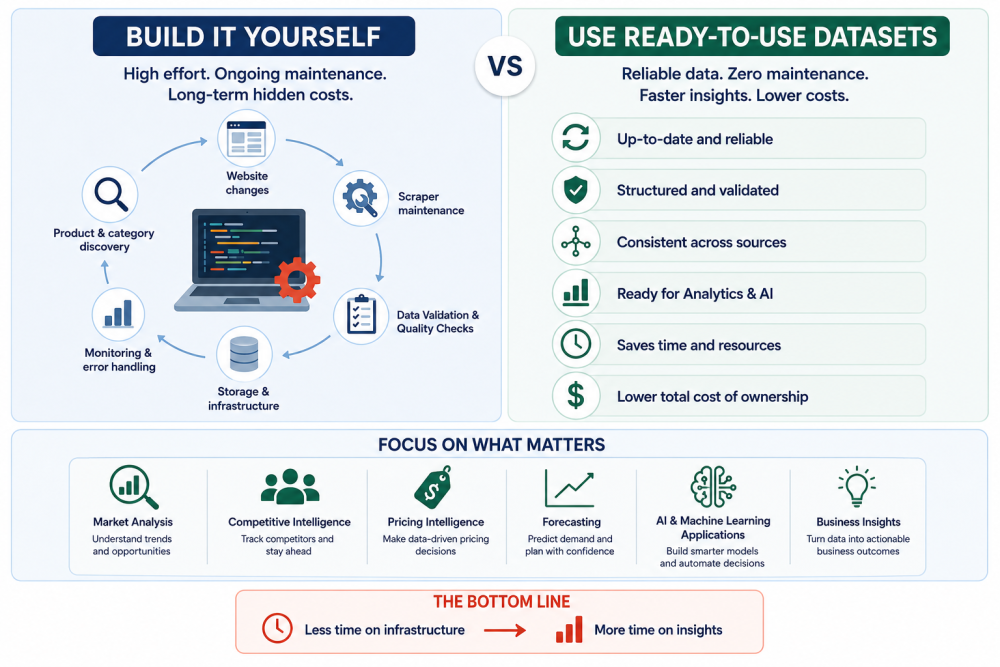
Figure 1. Building retail data infrastructure involves much more than collecting data. Organizations must continuously maintain collection systems, validate outputs, monitor quality, and adapt to source changes. Ready-to-use datasets reduce this operational burden and allow teams to focus on analysis and decision-making.
What Businesses Actually Need
Most organizations are not interested in scraping themselves.
They want answers.
They want to know:
- What are competitors charging?
- Which products are available?
- How are categories evolving?
- Which brands are gaining visibility?
- How are assortments changing over time?
To answer these questions, businesses need structured datasets rather than raw collections of pages.
The value comes from reliable, usable data—not from the collection mechanism itself.
The Cost of Maintaining Retail Data Infrastructure
The initial development of a scraper is often only a fraction of the total investment.
Over time, organizations may need to allocate resources to:
- monitoring source changes
- updating collection logic
- validating datasets
- maintaining storage and processing infrastructure
- handling data quality issues
- supporting analytical workflows
As data coverage expands across additional retailers, categories, and markets, operational complexity often increases as well.
For many organizations, the long-term cost of maintaining reliable retail data infrastructure exceeds the cost of the initial implementation.
Build vs Buy
For organizations with dedicated data engineering teams and highly specialized requirements, building internal retail data infrastructure may be the right choice.
For many others, purchasing ready-to-use datasets can significantly reduce operational complexity.
Instead of maintaining data collection infrastructure, teams can focus on:
- market analysis
- competitive intelligence
- pricing intelligence
- business reporting
- forecasting
- AI and machine learning applications
The decision is often less about technology and more about resource allocation.
The question is not whether a company can build its own retail data infrastructure, but whether maintaining that infrastructure creates more value than focusing on the insights the data is meant to deliver.
Organizations that build internally gain greater control and customization. Organizations that purchase ready-to-use datasets often reduce operational overhead and accelerate access to business insights.
Conclusion
Retail data projects often begin with a scraper.
Successful retail intelligence programs are built on something much larger: a reliable process for collecting, validating, structuring, and continuously updating data over time.
For many organizations, the challenge is no longer how to collect retail data.
The challenge is how to obtain reliable data quickly enough to support business decisions.
As retail markets continue to evolve, ready-to-use datasets can help organizations spend less time maintaining infrastructure and more time generating insights.
Looking for Retail Data Without the Infrastructure Overhead?
Building and maintaining retail data pipelines requires continuous investment in engineering, monitoring, validation, and quality control.
If your goal is to analyze markets, monitor competitors, support pricing decisions, or develop AI applications, ready-to-use datasets can significantly reduce the time and resources required to get started.
Datasets.store helps organizations access structured retail and ecommerce data that is already collected, validated, and prepared for business use.
Explore available datasets or contact our team to discuss your specific data requirements.
Recent Posts