We use cookies to make your experience better. To comply with the new e-Privacy directive, we need to ask for your consent to set the cookies. Learn more.
Insights
UK Grocery Supermarket Data: Products, Prices, and Market Insights
on
June 30, 2026
Prices, promotions, and product assortments change constantly across UK supermarkets. New products appear every day, promotional campaigns reshape pricing strategies, and retailers continuously adjust their offerings to respond to consumer demand.
For businesses involved in competitive intelligence, market research, pricing analytics, business intelligence, and AI development, understanding these changes requires access to reliable grocery data.
This is where grocery datasets become valuable. Access to structured product, pricing, category, brand, and assortment information helps organizations analyze the market at scale and make data-driven decisions.
Why United Kingdom Grocery Data Matters
The United Kingdom grocery market is one of the largest and most competitive retail sectors in Europe. Major supermarket chains manage extensive product catalogs spanning food, beverages, household goods, and personal care products. Strong competition among traditional supermarkets, discount retailers, and online grocery platforms makes UK grocery data particularly valuable for market intelligence and pricing analysis. As a result, access to reliable supermarket data has become increasingly important for organizations seeking visibility into market activity and competitive dynamics.
A modern retail product dataset allows businesses to monitor product availability, analyze pricing strategies, track assortment changes, and better understand how products are positioned across multiple retailers.
Major UK Supermarkets
The UK grocery market includes several major retailers that collectively serve millions of consumers and represent a significant share of national grocery sales.
Key retailers commonly included in grocery datasets are:
- Tesco
- Sainsbury's
- Asda
- Morrisons
- Ocado
- Aldi
- Lidl
- Waitrose
- Marks & Spencer
These retailers represent different segments of the UK grocery market. Tesco, Sainsbury's, Asda, and Morrisons operate large-scale supermarket networks with extensive product assortments. Aldi and Lidl focus on discount retail models, while Ocado is a major online grocery retailer. Waitrose and Marks & Spencer serve more premium market segments.
Together, these retailers offer hundreds of thousands of products across food, beverage, household, and personal care categories. This diversity makes UK supermarket data particularly valuable for comparative pricing analysis, assortment monitoring, category research, and competitive benchmarking.
What Is Included in a Grocery Dataset
A grocery products dataset typically contains information about products available through supermarket websites and ecommerce channels.
Depending on the retailer and dataset structure, available attributes may include:
Product Information
- Product name
- Brand
- Product description
- Package size
- Product identifiers
- Images and URLs
This type of food product data can support product catalog management, product matching, assortment analysis, and market intelligence initiatives.
Pricing Information
A food prices dataset may include:
- Regular prices
- Promotional prices
- Discount information
- Multi-buy offers
Access to grocery pricing data allows organizations to compare pricing strategies across retailers and monitor changes within specific categories or brands.
Category Information
A food product dataset often contains category hierarchy information that helps businesses understand how products are organized across supermarket catalogs.
Examples include:
- Dairy products
- Meat products
- Bakery products
- Beverages
- Frozen foods
- Snacks
- Household products
- Personal care products
Availability Information
Many retail product datasets also include product availability signals that indicate whether products are currently listed, temporarily unavailable, or removed from the assortment.
Availability data helps businesses monitor assortment changes, identify discontinued products, and track product visibility across retailers.
What Can Businesses Learn From UK Grocery Data
Access to structured supermarket data is valuable not only because it contains product and pricing information, but also because it reveals broader market dynamics.
By analyzing grocery data across multiple retailers, businesses can identify:
- pricing differences between competing supermarkets
- category growth and decline trends
- product launches and assortment expansion
- private label development
- promotional activity across categories
- brand visibility and retailer positioning
For example, comparing pricing and assortment data across Tesco, Sainsbury's, Aldi, and Lidl can help businesses understand how different retailers compete within specific product categories and how pricing strategies evolve over time.
These insights support decision-making in pricing, category management, product development, market research, and competitive analysis.
Challenges of Tracking Grocery Products and Prices Across UK Retailers
At first glance, grocery retail data may seem relatively straightforward. Supermarkets publish product information online, making it possible to collect product names, prices, brands, and categories.
In practice, however, retail product datasets are highly dynamic.
UK supermarkets continuously update their product catalogs. New products are introduced, seasonal items appear and disappear, packaging changes, and existing products may be renamed or moved between categories. Retailers also adjust assortments in response to supplier changes, consumer demand, and market trends.
Pricing is equally dynamic. Promotions, discounts, multi-buy offers, and temporary price reductions can significantly change product prices over short periods of time. As a result, a dataset collected today may look very different just a few weeks later.
Another challenge is consistency across retailers. Similar products may be described differently, categorized under different hierarchies, or use different naming conventions. This can make cross-retailer analysis more complex, particularly when businesses need to compare prices, assortments, or brand performance across multiple supermarket chains.
For organizations relying on grocery market data, maintaining accurate and up-to-date datasets is often just as important as collecting the data itself. Completeness, consistency, and attribute-level quality all play a critical role in ensuring that the resulting insights remain reliable and actionable.
Who Uses Grocery Datasets
Structured grocery data supports a wide range of business, research, and analytical use cases across the retail ecosystem.
Retailers
Retailers use grocery pricing data to monitor competitors, compare assortments, and identify market opportunities.
Consumer Brands
Manufacturers and consumer brands analyze food product data to understand product positioning, monitor distribution, and evaluate category performance across retailers.
Market Research Companies
Researchers use supermarket data to analyze market trends, pricing strategies, and category development.
Data and AI Teams
Structured grocery data can be used to build recommendation systems, forecasting models, product matching solutions, and analytical applications.
Consulting and Investment Firms
Consultants and investors often rely on retail product data and supermarket pricing data to evaluate market activity and identify emerging trends.
Data Quality Considerations
The usefulness of a grocery dataset depends not only on its size but also on its quality.
A dataset containing millions of records may still have missing attributes, inconsistent values, or duplicated information. For businesses relying on external retail datasets, understanding these factors is essential before using the data for analytics, market research, or AI applications.
One of the challenges when evaluating third-party datasets is limited visibility into their actual quality. Buyers often know how many records a dataset contains but have little information about the completeness and reliability of individual attributes.
At Datasets Store, data quality is evaluated at the attribute level rather than treated as a single score. For each dataset, users can review quality metrics for individual fields and better understand the structure and completeness of the data before making a decision.
Available metrics may include:
- Fill Rate
- Uniqueness
- Distinct Value Ratio
- Duplicate Rate
These metrics help answer practical questions such as:
- How complete is a particular attribute?
- How many unique values does it contain?
- How much duplication exists within the field?
- Which attributes provide the highest analytical value?
Rather than treating dataset quality as a black box, customers can evaluate the quality of individual attributes and determine whether a dataset is suitable for their specific use case.
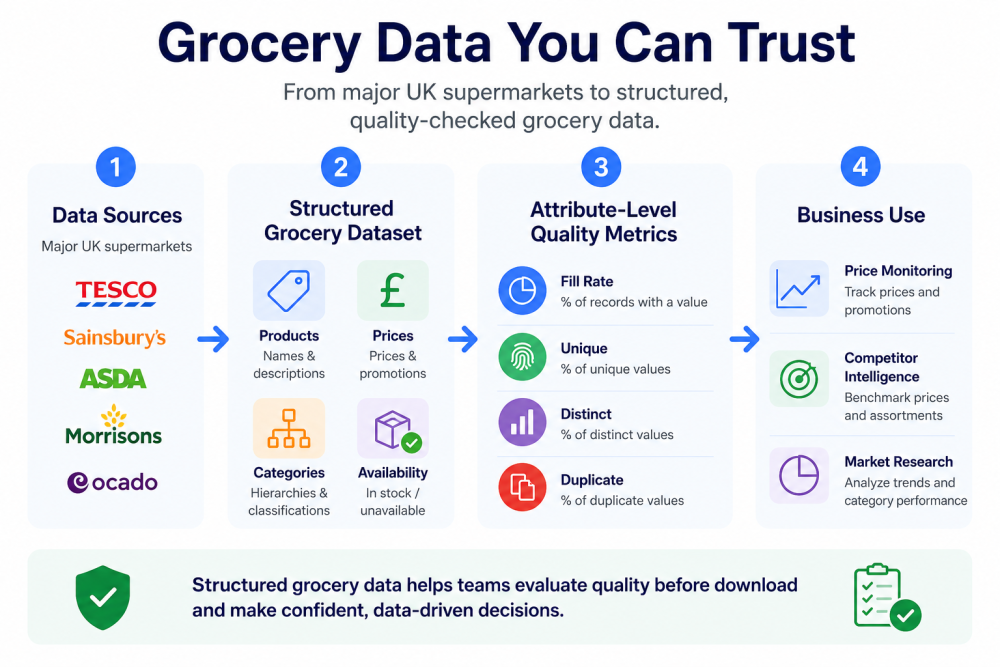
Example of a structured grocery dataset built from product, pricing, category, availability, and quality metrics collected across major UK supermarkets.
Accessing UK Grocery Datasets
Organizations seeking grocery datasets, food prices datasets, supermarket pricing data, or structured food product data often face a choice between building their own data collection process and using existing ready-to-use datasets.
Building an internal collection process can provide flexibility, but it also requires ongoing maintenance, retailer coverage management, data validation, and quality control. Ready-to-use datasets provide faster access to structured product, pricing, category, and assortment information while reducing the operational effort required to maintain coverage across multiple retailers.
Datasets.store helps organizations access structured grocery data from major UK supermarkets and other retail markets, including product, pricing, category, availability, and assortment information.
Conclusion
United Kingdom grocery supermarket data provides visibility into product availability, pricing dynamics, category structures, and assortment changes across one of Europe's most competitive retail markets.
Beyond supporting pricing analysis and market research, structured grocery datasets help businesses identify competitive trends, monitor retailer strategies, and uncover opportunities within specific product categories.
Whether the goal is competitive intelligence, pricing optimization, category management, or AI development, access to reliable grocery data allows organizations to focus on generating insights rather than collecting and maintaining data.
As grocery markets continue to evolve, high-quality retail datasets are becoming an increasingly important resource for businesses that depend on timely, accurate, and comprehensive market information.
Looking for UK Grocery Data?
Explore available datasets on Datasets.store or contact our team to discuss custom data requirements and dataset sourcing options.
Related Datasets

Comments
Recent Posts