We use cookies to make your experience better. To comply with the new e-Privacy directive, we need to ask for your consent to set the cookies. Learn more.

Use Cases
Peculiarities of the Automotive industry and the power of datasets
on
January 23, 2026

The automotive industry is a complex ecosystem shaped by many factors — from regional nuances and economic conditions to consumer income levels, local regulations, brand loyalty, and supply chain logistics.
Success in this field depends on understanding and adapting to these peculiarities. Some challenges — like navigating international regulations or managing global supply chains — are inherently complex. Others, however, can be effectively addressed with data-driven decisions.
The key? Getting the right data — including a reliable automotive dataset that reflects your market realities.

Why is data critical in the automotive market?
Collecting market intelligence manually — for example, monitoring competitors’ spare parts prices — can be exhausting and counterproductive, especially when dealing with hundreds of thousands of SKUs across multiple regions.
This is where comprehensive automotive data sets become a game-changer. They allow manufacturers, distributors, and retailers to make decisions based on facts, trends, and logic, rather than on guesswork.
What are datasets in the automotive industry?
In business terms, a dataset is a structured collection of information gathered from one or more sources. In the automotive industry, datasets can include:
- Product names, SKUs, and technical specifications
- Pricing for both OEM (original equipment manufacturer) and aftermarket products
- Availability and stock levels
- Customer ratings, reviews, and demand trends
When sourced and updated regularly, an automotive dataset becomes the foundation for market analysis, competitor benchmarking, and strategic planning. Many businesses also look for formats such as an automobile dataset CSV download to easily integrate data into BI tools and analytics pipelines.
What is a MAP policy — and why does it matter?
A Minimum Advertised Price (MAP) policy is an agreement between a manufacturer and its retailers stipulating that the retailer will not advertise a product below a certain pre-set price.
- Purpose: Maintain consistent brand image and prevent damaging price wars
- Impact: Helps protect both manufacturer and retailer profit margins
- Note: Retailers may still sell below the MAP price — but they cannot advertise that lower price
Example in an automotive context: A tire manufacturer enforces a MAP policy to ensure its premium tires are not advertised at bargain-basement prices online. This helps sustain the perception of quality and keeps pricing aligned across different retail channels.
How can automotive businesses use datasets?
1. How can you compare spare parts prices across markets?
- Monitor both OEM and generic alternatives
Example: A major vehicle and parts manufacturer wants to track over 400,000 products across 20+ countries, focusing on 1–2 key online spare parts marketplaces in each country. By partnering with a data provider, they can automatically track market changes, detect pricing shifts, and adjust strategies.
2. How can you compare a single product’s price across platforms and regions?
- Track the price of the same product across multiple marketplaces and countries
Example: A popular shock absorber sells for €120 on a German marketplace but €150 on a French one. The manufacturer uses this data to adjust its pricing strategy and ensure competitiveness without eroding margins.
3. How can you compare local and foreign markets?
- Identify differences in pricing, product availability, and demand between domestic and international markets
Example: A European retailer uses datasets to compare spare parts prices in Eastern vs. Western Europe, finding significant gaps in aftermarket brake pad pricing — and using this insight to source more cost-effective suppliers.
4. How can you track popularity based on customer purchasing power?
Demand for certain vehicle models or spare parts often depends on regional income levels and economic conditions.
Example: In high-income markets, premium alloy wheels may be in high demand, while in emerging markets, affordable steel wheels dominate sales. Automotive datasets reveal these patterns so companies can tailor stock accordingly.
5. How can you identify new market opportunities faster?
- Spot gaps in product availability or unmet demand
Example: Data analysis shows that in Southeast Asia, there’s growing demand for hybrid vehicle components, but local suppliers offer limited stock. A retailer moves quickly to fill the gap.
6. How can you optimize inventory and forecast demand?
Accurate data helps plan stock levels to avoid overstocking or shortages.
Example: A distributor notices seasonal spikes in demand for winter tires across Northern Europe and adjusts its ordering cycle accordingly.
7. How can you measure and track market share?
Understanding market share helps manufacturers and retailers evaluate competitive positioning:
- Identify the percentage of sales your brand holds in a specific category or region
- Compare your share against competitors and track changes over time
- Spot threats from emerging players before they erode your position
Example: An automotive battery manufacturer tracks market share data quarterly and notices a consistent drop in one region due to a competitor’s aggressive marketing — prompting a timely promotional campaign to recover ground.
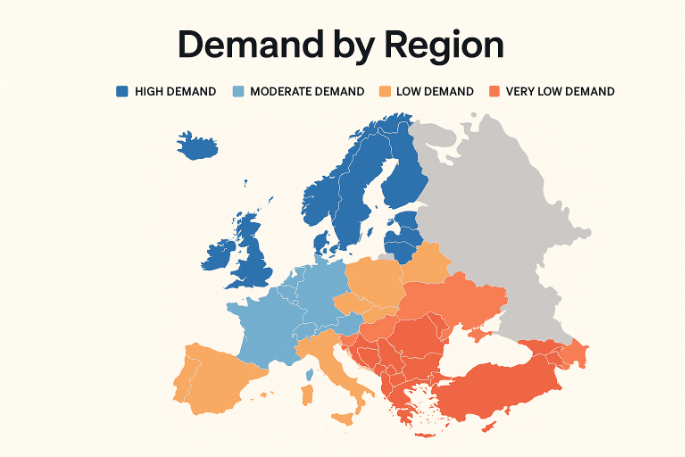
8. How can you measure demand by region?
Analyze which regions have the highest and lowest demand for specific parts or models.
Example: Data shows that electric vehicle charging cables are in high demand in Northern Europe but have low adoption rates in parts of Southern Europe. This insight guides targeted marketing and distribution.
9. How can sentiment analysis from customer reviews help automotive brands?
Leverage customer feedback to improve products, service, and marketing messages.
Example: Sentiment analysis of reviews for a specific brake pad model shows recurring complaints about noise. The manufacturer uses this insight to update the design and highlight the improvement in marketing campaigns.
What spare parts sources can be used for data collection?
When building datasets, businesses can gather data from both international and local marketplaces, depending on their target regions.
International sources:
- Autodoc – Large online automotive parts retailer operating across Europe
- eBay Motors – Global platform for new and used automotive parts
- Amazon Automotive – Wide range of OEM and aftermarket parts
- Partslink24 – OEM spare parts portal for multiple car brands
Regional / Local sources:
- Oscaro – France-based online parts store
- Mister Auto – Operates in multiple European countries
- Motorcycle Spare Parts – Netherlands-based motorcycle parts platform
- Repco – Australia and New Zealand automotive parts chain
These sites can be monitored for pricing, availability, product specifications, reviews, and promotions, forming the backbone of competitive analysis datasets. Many companies start with an Amazon automotive dataset to benchmark pricing and assortment trends at scale.
Why choose Datasets.store as your data partner?
Datasets.store is a trusted provider of ready-to-use automotive data sets designed to integrate seamlessly into your market and pricing analysis tools.
We offer Amazon Automotive dataset coverage across 15 subcategories, including Car Care, Oils & Fluids, Tires & Wheels, Replacement Parts, and more. You can also purchase the full Automotive category bundle, which includes all 15 subcategories in one package.
Choose the delivery option that fits your needs for your automotive dataset — one-time delivery or recurring updates, along with your preferred data format. If your team requires an automobile dataset CSV download, we can deliver the data in a format that fits your workflow.
To sum up — how can datasets help you win in the automotive sector?
In the competitive automotive sector, success depends on understanding your market and acting faster than competitors. High-quality datasets give you the insights you need to make informed, profitable decisions — from pricing and inventory management to market expansion strategies.
To explore available automotive ecommerce datasets, visit the page.
Related Datasets




Comments
Recent Posts