We use cookies to make your experience better. To comply with the new e-Privacy directive, we need to ask for your consent to set the cookies. Learn more.

Use Cases
Electronics market overview and the role of datasets in staying competitive
on
January 27, 2026
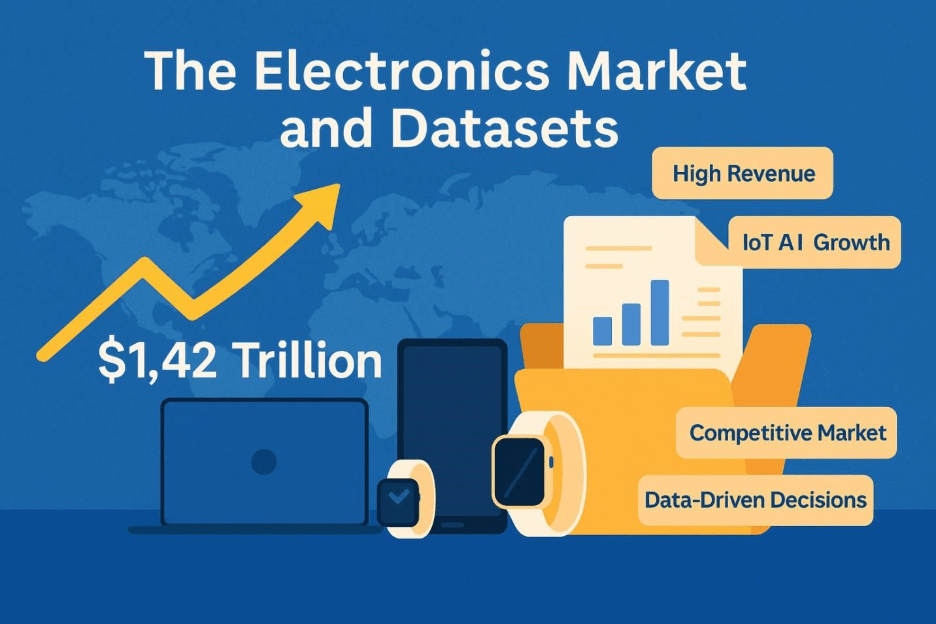
The overall global electronics market (covering both consumer and industrial electronics, components, etc.) was valued at approximately USD 788.6 billion in 2024, and is forecast to grow to ~USD 1.42 trillion by 2033 at a CAGR of 6.2%.
The consumer electronics segment, fueled by gadgets, media devices, wearables, and smart home products, represents a large portion of the industry. It already exceeds USD 1 trillion in 2024 and is projected to continue its upward trend into the next decade.
Forecasts vary, but most expect CAGRs between 2.8% and 6%, depending on market scope and methodology.
Summary Table
| Market Segment | 2024 Estimate | Forecast & CAGR |
| Overall Electronics Market | USD 0.8 – 1.24 trillion | Growing to 1.4 – 1.75T by 2030s (6–7%) |
| Consumer Electronics Market | ~USD 1.0 – 1.4 trillion | Up to 2.1 – 2.15T by 2030–2033 (5–9%) |
| Asia-Pacific | ~50% share (~USD 536B) | — |
| North America (U.S.) | ~USD 186B | — |
| Europe | ~20% share, growing | — |
What are the key insights about the global electronics market?
The global electronics market is resilient and constantly expanding, driven by IoT, AI, 5G technology, and the smart home ecosystem.
- Consumer electronics alone generates over USD 1 trillion annually, with strong growth ahead.
- Asia-Pacific dominates with nearly half of the global market share, backed by massive manufacturing hubs and a growing middle class.
- North America holds a strong share, led by the U.S. market, driven by high disposable incomes and early adoption of tech innovations.
- Europe remains stable with rising demand for sustainable, smart devices.
- Most countries feature 1–3 dominant national retail chains in consumer electronics, with some regions hosting multinational powerhouses like MediaMarktSaturn.
How can you stay competitive in a market this big?
The answer: datasets.
Whether you are a global or local retailer, wholesaler, or manufacturer, an Ecommerce dataset is key to tracking market information and turning it into a competitive advantage. Many companies rely on structured ecommerce datasets to monitor pricing, availability, demand, and market share across channels and regions.
Publicly available sources — from global marketplaces to national retail chains — can be used to build datasets that include:
- SKUs and product names
- Technical specifications
- Stock availability and levels
- Pricing data (retail & wholesale)
- Customer ratings and reviews
- Market share insights
- Seasonal demand patterns
This type of structured retail product dataset supports analytics, competitive benchmarking, and long-term planning.
How can electronics businesses use datasets?
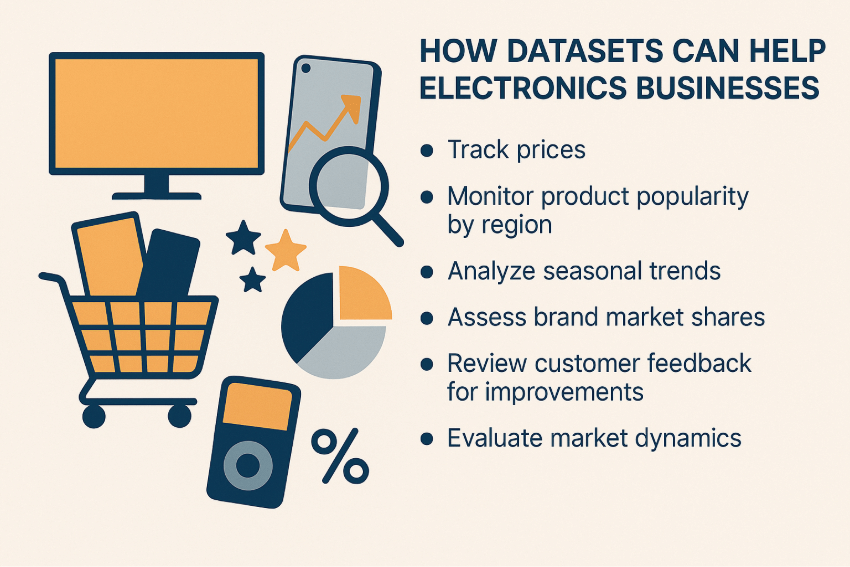
1. How can you track prices more effectively?
Monitor competitor pricing to adjust your own strategy.
Example: A major retailer tracks the prices of 50,000 SKUs across Amazon, Best Buy, and Walmart weekly to remain competitive without undercutting unnecessarily.
2. How can you measure product popularity by region?
Understand which products sell best in specific markets.
Example: Data shows that high-end gaming laptops dominate in North America, while budget-friendly models outsell them in Southeast Asia.
3. How can you follow seasonal trends?
Spot recurring sales cycles to optimize promotions and inventory.
Example: Smart TV sales spike in Q4 ahead of holiday seasons in both Europe and the U.S.
4. How can you track brand market share?
Identify which brands are gaining or losing ground.
Example: Tracking smartphone market share reveals that a mid-tier brand has gained 3% in a specific region, signaling a growing threat.
5. How can customer reviews support product improvements?
Extract insights from ratings and reviews to inform product design.
Example: Sentiment analysis shows repeated mentions of battery overheating in a popular tablet, prompting a design update.
6. How can you monitor market dynamics over time?
Track changes in pricing, product availability, and demand to anticipate shifts.
Example: Spotting a sudden drop in availability of a certain microchip alerts manufacturers to potential supply chain issues.
7. How can you track innovations and new product launches?
Stay ahead of technology trends.
Example: Dataset analysis flags a rise in sales of AI-enabled home assistants, prompting a retailer to expand its smart home section.
What are common sources of electronics data?
Global marketplaces:
- Amazon
- eBay
- Alibaba / AliExpress
- Newegg
Major retail chains:
- Best Buy (U.S.)
- MediaMarktSaturn (Europe)
- Currys (UK)
- JB Hi-Fi (Australia/NZ)
- Bic Camera (Japan)
Local/Emerging market platforms:
- Flipkart (India)
- Kogan (Australia)
- Cdiscount (France)
- Falabella (Latin America)
Many businesses start with an Amazon electronics database or consumer electronics product database to benchmark pricing and assortment across categories. In particular, an amazon electronics dataset is widely used for product intelligence, market monitoring, and trend tracking.
Why choose ready-made ecommerce datasets instead of collecting them manually?
Collecting and maintaining datasets manually is complex, time-consuming, and costly — often requiring a dedicated internal team.
Datasets.store offers a smarter alternative with ready-made ecommerce electronics product datasets that are easy to integrate into your workflows. If you’re looking to buy ecommerce datasets, buy ecommerce data, or quickly scale your analytics without building internal scraping pipelines, ready-made datasets are the fastest path.
We deliver structured, ready-to-use datasets that are:
AI-ready — optimized for machine learning, predictive modeling, recommendation engines, and natural language processing
BI-ready — designed for seamless integration into dashboards, analytics platforms, and reporting systems, enabling faster, data-driven decision-making
With our datasets, you can focus on strategy, innovation, and growth — while we take care of the complexity behind data collection and preparation.
Learn more: Electronics datasets
Wrapping it up: why does data matter in electronics?
The electronics market is vast, competitive, and rapidly evolving. To succeed, you need accurate, timely data to guide your decisions — from pricing and inventory planning to market expansion and trend analysis.
With Datasets.store you can gain the insights needed to move faster, reduce risks, and seize opportunities in a trillion-dollar industry.
Related Datasets




Comments
Recent Posts